Friday, November 4, 2011

I'm Too Uncultured to do Anything but Laugh at Modern Art

Last week was the opening of the "Jerusalem Art Show," which was a venue for contemporary art in the Old City of Jerusalem. When I heard about it, I had two thoughts go through my head: "I don't do large groups of artists walking around smoking and talking about the deeply moving inspiration caused by those streaks of paint," and "This could be pretty cool. At the very least, I'd have something to blog about!"

So naturally I went. It was all for you, dear blog readers. And for me, since I needed a good laugh.

When I got to the starting point (we were going to walk around the Old City to several different venues), I thought to myself, "Yeah, I really don't do large groups of artists walking around smoking and talking about the deeply moving inspiration caused by those streaks of paint, but I'm sure I'll have some crazy stories to blog about!" And I wasn't disappointed.

The first building we went in was still under construction/renovation. Like everything else in the Old City, the walls were cracked and the staircase was temporary and pretty questionable. One of the artists was doing a presentation, and we all had to wait and go in 5 at a time (the room was pretty small). Before we went in, we were asked to agree on a performance (from a list of 7) that the artists would do for us. We picked #7, which had as its description an old Chinese story. This told us absolutely nothing about what he would actually do, which should have been my first clue.

I started getting really nervous when we walked in because there was a man dressed all in black and wearing a ski mask standing there. I immediately went into "emergency mode," looking around for possible exits in case things got out of hand. However, then someone mentioned that he was from Taiwan, and my fears of Hamas-led "art" immediately vanished.

When we came in, he asked for a volunteer to move the pile of sand on the floor about 6 inches to the left with the shovel while he did the same to another pile of dirt behind the table. As this occurred in silence, the rest of us searched desperately for some sort of meaning or inspiration (well, most of the rest of us--I was struggling to hold back the laughter).
And then, that was it. He finished moving the pile of dirt, walked over and saw that the other woman had moved the pile of dirt, and called for the next group of spectators to choose a performance.
I walked outside quickly and tried to compose myself (I was laughing pretty hard), while the rest of the people in my group kept asking each other, "What was he doing? What did it mean?" "Well," I wanted to say, "He was moving a pile of dirt. It means that now he has twice as much floor area covered with dirt than he did before." But I didn't say anything.

AND THEN. One of the guys from my group came up and asked me, "What was he doing? What did it mean?" "I have no idea," I said. "Oh," he said. "I guess that's art, right? Imagination."

"Or dirt," I thought.

But it turns out that this guy was much more interesting that piles of dirt being moved around. He was from France and was on a solitary "tour of the world." And he'd been out for a year and had explored all of Asia!! Pakistan, Thailand, Vietnam, China, Syria...he'd been all over. He said he planned another year to hit Africa and South America. And he was just traveling by himself, sleeping in hostels, mingling with the locals, and backpacking around the world.

Guys. What an AWESOME idea. I don't think I would ever have the money (or the emotional stamina) to do such a thing, but just talking to him about what he had done made me think for just ten seconds about doing a similar thing. (The crazy thing is he said he'd only spent about 9,000 Euros in that year!)

And the oddest thing? He spoke Chinese and had lived in China for a couple of years! For some crazy reason I keep running into Chinese speakers--but a guy from France doing a tour of the world that was fluent in Chinese?! My life is so weird.

There were some other exhibits, including this one about olive trees that I didn't really understand, but with the ice broken with the first show, I could laugh about all of them (and all the artists smoking and talking about the deeper meaning of life) without feeling uncultured.

I did get to go out on some rooftops and get some pretty spectacular views of the city, though!


I guess I'm just not cultured enough to appreciate modern art...

Wednesday, November 2, 2011

Picking Olives in Bethlehem

A couple of weeks ago I got an email from my friend, Sahar (who also happens to be the district Relief Society president here in the Holy Land). "Sorry for the late notice," she said, "but do you want to do a service project in Bethlehem? We need someone to come help us pick olives."

After mocking her that her "service project" involved picking the olives off of her own trees, I gladly volunteered to help. I mean, who hasn't always wanted to go and pick olives in Bethlehem?

Picking olives is hard work! It doesn't seem like it would be, but each tree holds so many olives, and they are difficult to see among the leaves and branches. The process goes something like this: grab a branch, start at the top, and slide your fingers along it, pulling the olives off as you get to them. This makes it much less tedious than picking them off one by one!

It might not sound that hard, but it took five of us several hours to do two trees. Climbing in the trees to get the olives at the top are my fellow Mormon Hebrew U students Joseph, Becky, and Greg. (On a totally unrelated note, how odd that there are 4 Mormon students at Hebrew U this year! I will write more about this later, but the emphasis in the papers recently on Mormons and the large number of Mormon students at Hebrew U (4 is a lot for a place like Jerusalem!) makes me think that Mormons are taking over the world sometimes!)

After you pick the olives off of the branches, you let them drop to the blankets that have been spread all over the ground ahead of time. This makes it easier to gather the olives, but also helps the olives from getting bruised. Just be careful to not step on the olives on the ground (I took my shoes off while I was picking to minimize the damage) because you will crush them!


Oh, and in case anyone was wondering, freshly picked olives are disgusting. Absolutely terrible and bitter. I know this because I tried one. It was so bitter it made my mouth go numb for several minutes. 

And the best part of this service project? Last Sunday Sahar gave me a jar of olives and a bottle of olive oil--made from the very olives that I helped pick!

Saturday, October 29, 2011

The Moshav Part 2: Sukkot

I had such a delightful time at the Moshav during Rosh Hashanah that I went back for Sukkot. Sukkot is the biblical "Feast of Tabernacles," in which the Israelites were commanded to live in booths for seven days so that, according to the Leviticus 23, "your generations may know that I made the children of Israel to dwell in booths, when I brought them out of the land of Egypt."

In Israel, Sukkot is a festival of rejoicing. Having just finished Rosh Hashanah and Yom Kippur (both of which are very serious holidays), a week of Sukkot is like a week of partying here in Israel. One of my favorite parts of Sukkot, however, is the huge variety of sukkah that Jews build to eat (and sometimes sleep) in during the week.

This is a picture of Vered's family's sukkah.


A fun thing to do during Sukkot is to walk around West Jerusalem and the Old City and see the different types of sukkah set up all over. These next few pictures are just a few sukkot (plural of sukkah) in the Old City of Jerusalem.


This last one is overlooking the broad wall in Jerusalem, which dates back to the 8th century BC (and where the Assyrians and the Israelites duked it out during the reign of Hezekiah...the sukkah is inside the wall of Jerusalem, while I am standing where the Assyrians would have been, outside the wall). I get really excited about this wall because I love this story. Eat it, Assyrians!

Anyway. Many Jews in Israel eat in the sukkah, even the ones who aren't religious, but usually only the ultra-orthodox (and the children, who think it's great fun) sleep in the sukkah.

The trip out to the moshav was uneventful. Getting around Israel is quite simple, convenient, and cheap, comparatively--I went to the central bus station, got on a bus, paid about $5, and rode for about an hour before I got to the moshav. While Israeli bus drivers may not be the nicest people in the world (although some are!) and often make me feel like an idiot (I had to say the name of the moshav at least 6 times before the bus driver understood what I was saying, and he wasn't exactly patient with me!), they are usually pretty willing to tell you when you get to your stop. Just don't be offended if they grunt at you when you ask them to tell you when to get off.


This is what the bus stop closest to the moshav looks like: fresh air and miles and miles (kilometers and kilometers just doesn't have the same ring) of open space.


In my opinion, Jerusalem is a very exhausting city to live in (the clash of politics and history and culture seems to permeate everything), so it is wonderful to leave for a while and take a breath of fresh air. It's kind of like working in an office where everyone is smoking--no matter how much you love your work, it's such a relief to leave the smoke-filled rooms and step outside for a few hours!

My time at the moshav was wonderful. Vered and her family are superb hosts (and hopefully one day she will come visit Utah!) and although it was much less eventful than my adventure-filled stay during Rosh Hashanah, we ate our meals in the sukkah, which was delightful. And Vered is hilarious. Just a few examples: I have a bad habit of wiping my wet hands on my jeans after washing them in the kitchen (too many years of not having a dry dishcloth available, I guess). Anyway, Vered caught me once as I started wiping my hands on my jeans and said, "Use the dishcloth! Your pants will thank me." Another time I was telling her that in one of my apartments in Taiwan I poured bleach down the drain to kill the cockroaches that would come up out of the sink every day. When I mentioned that the bleach killed the cockroaches, she said, "Maybe. Or maybe they just came up the next day with blonde hair! 'Thank you' [she said as she flipped her long black hair], 'thanks for the new hair color!'"

I don't know if you all find that as funny as I did, but I was laughing about it for days and days.

My favorite thing, though, was when I told her I was Mormon. "You are?!! But you're so...normal! I thought Mormons wore long dresses and black suit coats with top hats..."

"Well, they did in the 1800's," I said, "but so did everyone else!" I laughed for hours when I realized that she thought Mormons and Amish were the same thing (we're not, by the way!).

[Side note: her mother did know what Mormons are and told me that she absolutely loves the Mormon Tabernacle Choir. "One day I was driving home and one of their broadcasts came on," she told me. "When I got home I just sat in the car to finish the broadcast, because I couldn't bear to miss even three minutes of the concert to come inside and turn on the radio!"]

So happy Sukkot, everyone. The holidays are over now and life is back to normal. My grad classes start tomorrow, and I will admit that I am just a little bit terrified! I'm not sure what to even expect, but I'm sure it will be the ride of my life...

Wednesday, October 26, 2011

Yom Kippur in Jerusalem

Yom Kippur, the day of atonement, is the holiest of Jewish holidays. This year, it was from sundown October 7 to sundown October 8. Yom Kippur is observed all over Israel, even by the non-religious Jews, and is a day of fasting, mourning, and prayer. And absolutely NO DRIVING.

I knew what Yom Kippur was before I came here, but when other branch members told me about "the day we can't go in to church," I was a little skeptical. Everyone in the Primary presidency (which, btw, I'm in the Primary presidency!) was really worried about what would happen to Primary. "None of us will be able to get in to church," they said. "They close the roads and no one drives. So only the children who live at the Jerusalem Center will be in church, but what will we do about Primary for those kids?"

I certainly didn't want to sit at my apartment alone all day while all the Jews in Israel were mourning, so I volunteered to spend the night with a member of the branch who lives in East Jerusalem and take care of Primary in the morning. But really, I thought, it can't be that hard to get in to church. It's nice to respect the holiest Jewish holiday, but surely some people drive on Yom Kippur. I mean, religious Jews don't drive on the Sabbath or other holy holidays, but that doesn't mean there aren't plenty of cars on the road causing traffic jams every holiday!

(Turns out that we just watched General Conference instead of having Primary, so I didn't have to do anything anyway, but that's beside the point.)

The point is, I went to meet my friend (Arlissa) Friday afternoon. She was getting off work early because "they close the roads and I won't be able to get home after 4."

I'm used to everything shutting down (busses, stores, and everything else) early Friday afternoon for Shabbat each week, so I wasn't surprised to see that there were very few cars on the road at 3 pm on the eve of Yom Kippur. But nevertheless, Arlissa and I both breathed a sigh of relief when we got out of West Jerusalem before 4, when the roads were supposed to close.

We decided to run and grab some groceries in Beit Hanina, an Arab area just outside of Jerusalem, and thought for sure that we would be safe, since we were just going from East Jerusalem to East Jerusalem.

But guys. When we tried to get out of Beit Hanina, THE ROADS WERE CLOSED. The police had come and put huge cement roadblocks in the road, and no traffic could get in or out.

Luckily, we found another route home without roadblocks, but I was astounded. The reason that no one drives on Yom Kippur is because the police enforce the no-driving rule by putting up roadblocks on all the roads!

Unfortunately, I didn't any pictures of the barriers, so you'll just have to imagine it. But if you come to visit Jerusalem during Yom Kippur, don't expect to be able to drive anywhere...

(As a side note, I was talking to an Arab man in a store that evening, and he said that this year was great because the police left most of the roads in East Jerusalem open so that the Arab population could go about their business, since they do not celebrate Yom Kippur. Only roads that went through or near Jewish areas were closed, but most of East Jerusalem was still accessible--which he said was a big improvement over previous years, when all the roads were closed.)

Saturday, October 22, 2011

Meeting the President

Each year, as a part of the Sukkot (the biblical Feast of Tabernacles) celebration here in Israel, the president of Israel opens up his house to greet visitors (meaning his yard is filled with displays and he comes out and makes a speech to the crowd). The week of Sukkot is like a great big party in Israel, as most people have a break from work and school. The first and last days of Sukkot are "holy" holidays, meaning they are like Shabbat (no work, no transportation, etc), but the middle days are filled with fun events. Museums are packed, there are concerts and special displays everywhere, and people stay out until the early hours of the morning partying in the streets (or going to synagogue, for the super religious ones). This makes it the perfect time for the president of Israel to host a "party" and promote a certain initiative.

Naturally, I didn't want to miss out on a chance to meet the president of Israel!

This year the president (Shimon Peres) was promoting a "green" initiative, so the decorations and displays were pulsing with the "friendly to the environment" vibe.

People were walking around dressed like kohlrabi and strawberries, you could take pictures with cardboard cutouts of recycling trucks, and there was a random satellite display (?) 


Oh, and don't forget the random missile in the middle of the yard (green initiative = promote the military?)

I was laughing with my friend about the amount of "propaganda" that permeated the event, showing Israel as a happy, family-friendly place that supports recycling and is friendly to the environment (and ignoring the bigger issues and problems currently facing this country). I decided that when it's your country, it's patriotism, but when it's another country, it's propaganda!


The pictures below were some sort of "recycled art."


And you better believe that I got a picture of the famous room! This is where the president of Israel often receives visiting dignitaries and politicians.

My fellow Arabic-speaking friends Sabra, Greg, and Beverli (taking the picture) went with me.

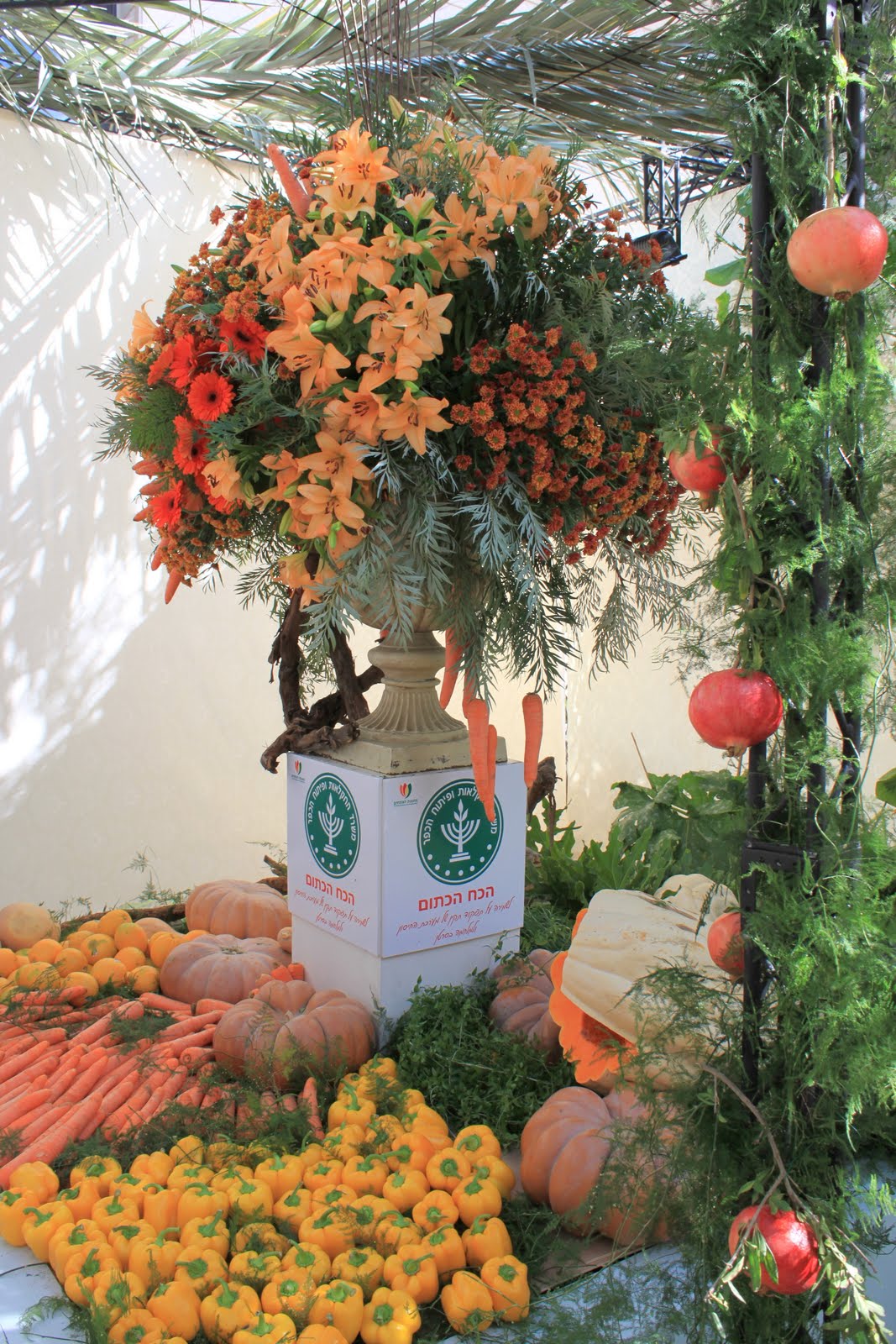
These stunning fruit-vegetable-flower displays served to promote the idea of a "green Israel."

And this random and slightly awkward picture of Beverli was really just an excuse to take a picture of Elvis. Bet you didn't know he's really in Israel, did you? (I think he had a part in the program, but we left before he sang...)

My favorite part of the whole event was the random people who kept walking around with plates of cookies. I guess whoever was in charge of the event decided that after we got through all that security, the best way to keep a restless crowd happy while waiting for the president to speak was with an endless supply of cookies!


Shimon Peres only spoke for about 10-15 minutes, but it was enough time for him to promote the prosperity and environmental friendliness of Israel--and for protestors to stand up and start shouting about the ridiculous costs of housing in Israel (protests have been going on for several weeks now because the cost of living in Israel is skyrocketing out of control) and for security to drag said protestors out.


I have to say that it was somewhat less of an ordeal than "meeting" President Obama this summer (which event I have yet to blog about!), but really, how many people can say they've "met" the president of Israel?

Sunday, October 16, 2011

Mahane Yehuda Market

Welcome to Mahane Yehuda market. It's a large market in West Jerusalem, complete with shouting vendors, huge crowds, and plenty of locals buying their fruits, vegetables, meat, and of course halva--not to mention the chocolately rolls of deliciousness that are famous here. I figured the best way for you, dear readers, to experience it was through a wordless photo essay, so here it is: