Showing posts with label Mormons. Show all posts

Monday, March 26, 2012

What's In A Name?

I know I still have several posts from Spain, Morocco, and Losaunne and Noelle's visit, but I was talking to my sister yesterday about the name of the place where I live/study and I thought it would be a helpful blog post.

This Sunday in the Bethlehem branch/group (more about that to come later), a letter from the First Presidency was read in sacrament meeting stating that the name of our district had been changed from the "Israel District" to the "Jerusalem District." The day before, I was visiting teaching at another West Bank member's house when we heard the announcement (via a phone call from another West Bank member).  When we heard the announcement, we were shocked and delighted. But why? Name changes don't usually elicit such rejoicing, especially since it is just the name of a district of The Church of Jesus Christ of Latter-day Saints.

But like everything else in Israel/Palestine, even names are complicated. Take the name of the place in which I live, for example. Where do you think I live? My mom recently made clocks for the different time zones of her children and put the names of the places we live on them: Utah, Texas, and Israel. I didn't tell her this (but I guess she'll know now!!) because she had already made the clock, but I don't actually live in Israeli territory, at least not according to the US government (as well as other countries and organizations). (It's ok, Mom, I still live in the same time zone :)

For those who don't know, Israel/Palestine is split politically, culturally, and ethnically. While many countries around the world have a large minority population that leads to political divisions, Israel/Palestine is different because in 1949 plans were drawn up that effectively split the country/territory (which had been under British Mandate before), giving the Israeli government control outside of the green line, the Jordanian government control inside of the green line/West Bank (it's called the West Bank because it's on the west bank of Jordan), and the Egyptian government/military somewhat in control of the Gaza strip (working with a Palestinian government there).

During the Six Day War in 1967, Israel took back the Gaza Strip and the Sinai Peninsula, the West Bank and East Jerusalem (Jerusalem had been divided in half by the green line), and the Golan Heights. Several UN resolutions, the Oslo Accords, and numerous political and diplomatic decisions later (if you want a brief overview, I suggest you read the Wikipedia article about the West Bank), the West Bank is now divided into three sections: Area C (under complete Israeli control and administration, meaning that if the Palestinians who live in Area C want to build onto their house or dig a well or anything they have to get permission from the Israeli army; Israelis are also allowed to travel freely in Area C), Area B (Israeli military control and Palestinian civil control), and Area A (full Palestinian Authority control; Israelis are forbidden to enter). I live in Area A, but just a 5 minute drive from my home to the east Area A ends and Area C begins.


So what is the legal status of the West Bank and East Jerusalem? Since 1979, the UN, the US, the EU, and other international organizations have referred to the West Bank and East Jerusalem as Palestinian territory occupied by Israel. Israel considers Jerusalem its capital, but most embassies (including the US) are located in Tel Aviv, the internationally recognized capital of Israel (because of the disputed status of Jerusalem). Jerusalem is its own entity, according to the US government, and is written "Jerusalem" on their documents and not "Jerusalem, Israel." 

So when I say where I study, I say Jerusalem. Where do I live? The West Bank, Beit Sahour, a little town near Bethlehem. I talk about the West Bank, Palestinian territory, Israeli territory, Jerusalem, the Gaza Strip, etc, but the area is complicated enough to make it impossible to assign just one name to it.

So what does all of this have to do with the Bethlehem church group and renaming the district? Well, there are about 28 people from the Bethlehem "group" (not quite a branch, but not part of any other branch--this includes children and family members who are not baptized but who attend church with their baptized spouse) that live in the West Bank. There are branches of the church in Jerusalem, Tel-Aviv, and Tiberias. These four areas constitute the district. And the First Presidency and Quorum of the Twelve Apostles cares enough about us to recognize the fact that not all of the members and not all of the branches are in Israeli territory. And the most neutral term that can describe us is the "Jerusalem District": even though it's not just Jerusalem members who are in the district, and not even all of the members of the district can go to Jerusalem, the status of the city is complicated and divided, just like everything else here, and therefore is pretty representative of the situation here.

So what's in a name? Apparently, despite what Shakespeare thinks, a name means quite a bit, at least here in the Middle East. And I hope you enjoyed this little history lesson.

Saturday, December 31, 2011

Christmas Eve in Bethlehem


When I was a child, Christmas was almost always a disappointment. Perhaps it came from that time I asked for a singing mermaid and Santa brought me a mermaid that didn't sing (one of the harsh realities of Santa having five kids and working on his PhD), which clearly traumatized me for life. There is always so much build-up, so much hype about Christmas, and then when Christmas comes, you open presents early in the morning and then it's like, "Now what? What do we do with all that built-up expectation for something awesome?" The two months of waiting and hoping and wishing leave me exhausted, and by 10 am I'm usually ready for Christmas to be over (so we can get January and February over with and get into spring).

For me, Christmas Eve is the real holiday. Big dinner, reading (or acting out) the nativity story, and the expectation for something awesome can still be built up for Christmas. At least in my family traditions, Christmas Eve was the day to focus on the birth of the Savior and His life and sacrifice, which Christmas was more focused on the spirit of giving (ie presents). 

This Christmas Eve offered me a unique chance to continue this tradition of a big dinner and a focus on the birth of the Savior while living a 15 minute walk away from the place tradition holds Jesus was born. And what better way than to celebrate with expats and Palestinians?

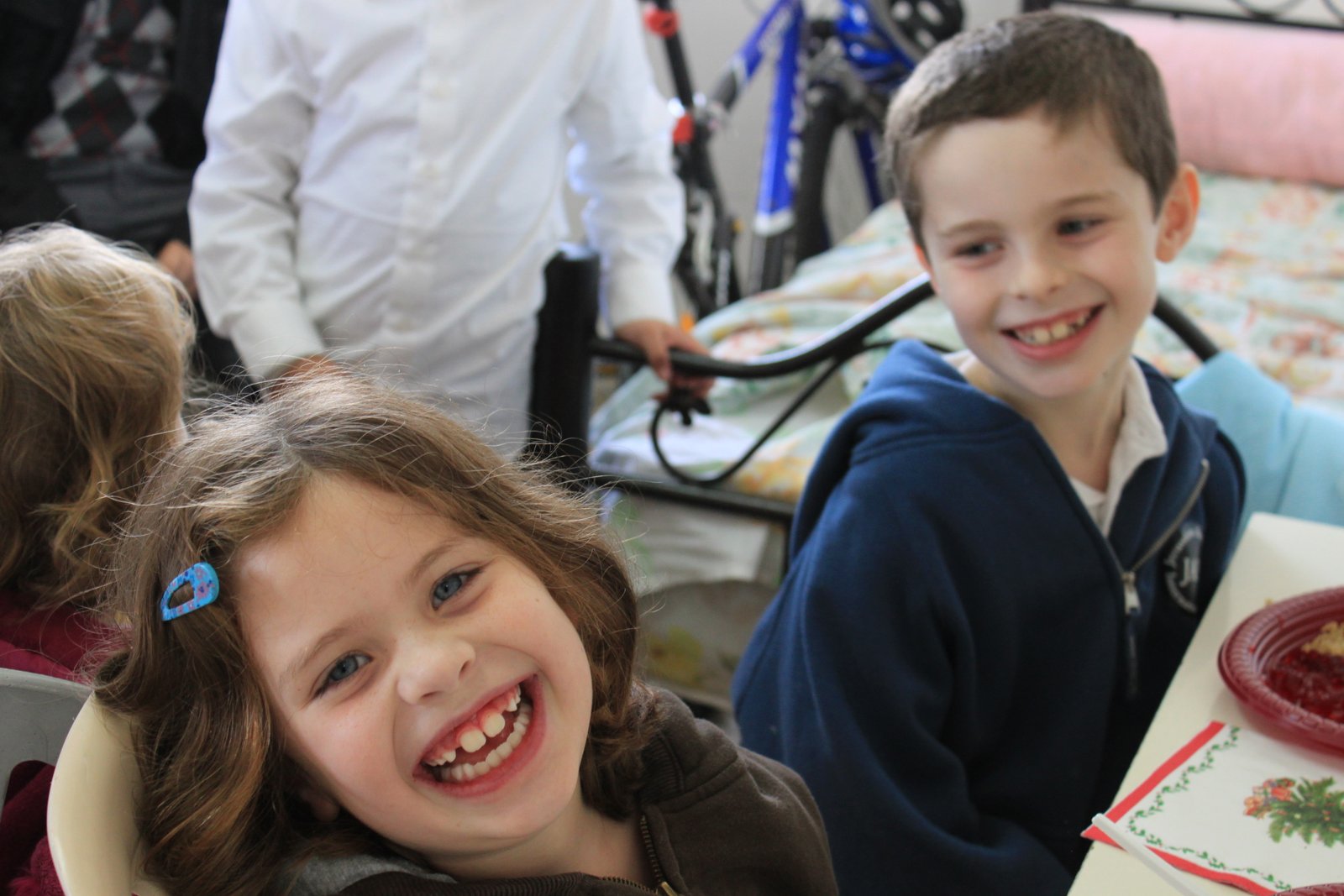
I invited the members of my LDS branch over to my spacious house for dinner, and I am proud to say that we fit more than 30 people in to my apartment! It was a choice opportunity for so many of our branch members to be together, as we had members from Ramallah and Bethlehem (who can't go in to Jerusalem to church) as well as several members from Jerusalem. It was a happy reunion as I tried to keep children from spitting off my balcony and throwing chairs at each other while the adults tried to communicate in their limited Arabic or English.

Yep, I'm so ghetto that I had people eating in my guest bedroom. And yes, I keep my bike in there.


Thankfully, we only had one major spill and a couple of meltdowns, we didn't run out of food (which, by the way, I was not in charge of--I'm not that ambitious!), and it almost felt like a big family gathered around my (minuscule) Christmas tree!


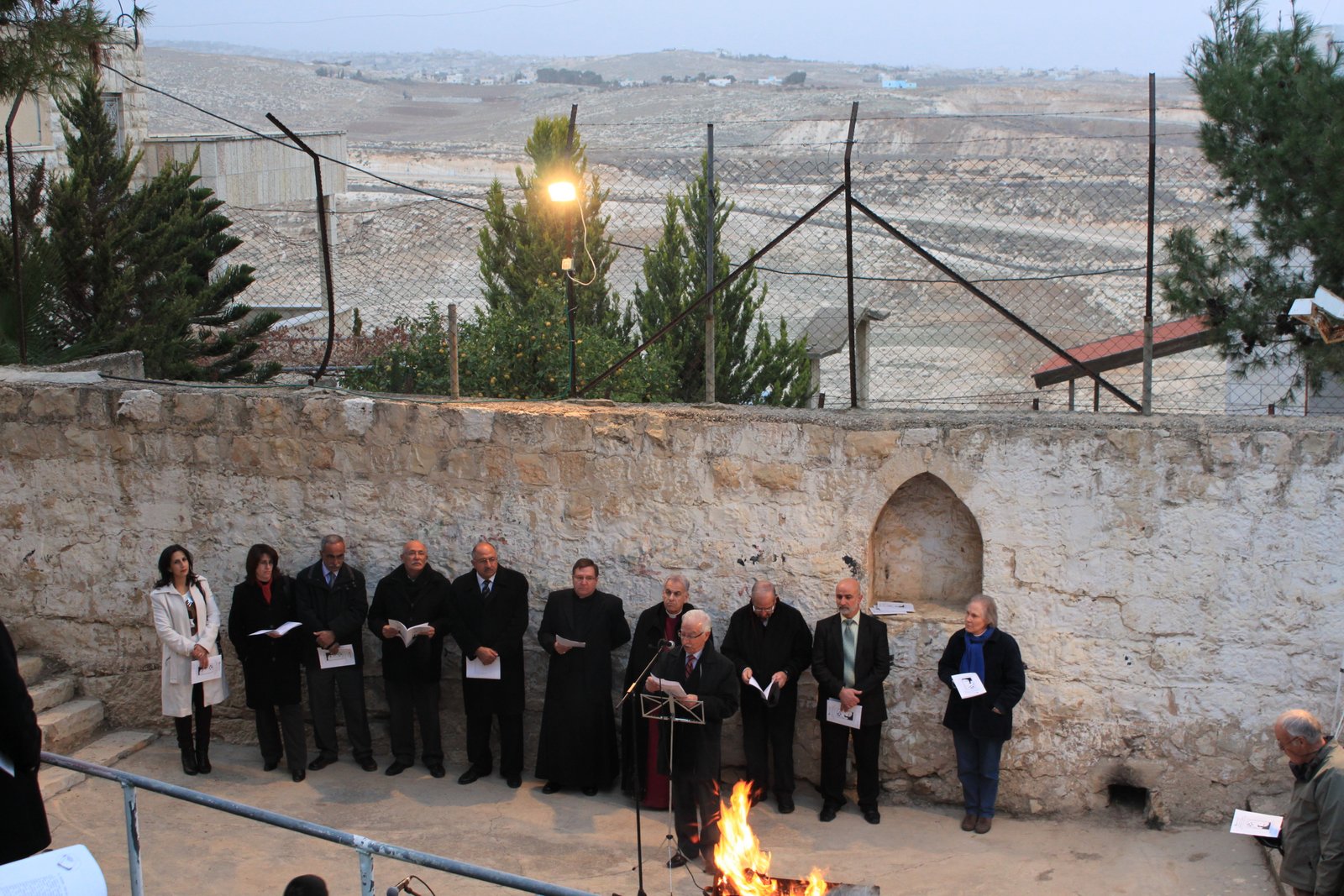
After the party went home, I went to a Lutheran/Catholic Christmas Eve service in Shepherd's Field. 


It was a beautiful service (more to come about it) and such an incredible experience to be sitting in Shepherds Field with members of several different denominations, singing and reading scriptures about the birth of the Savior. (And the Israeli settlement that is usually an affront to the eyes on the mostly-empty fields was just out of view, making the scene a bit more realistic!)


After the service, they shared lamb and pita (and the warmth of their fire) with everyone. So this Christmas Eve in Shepherds Field, instead of watching our flocks, we ate them.

Looking out over Beit Sahour and Bethlehem


Merry Christmas from the Koreans


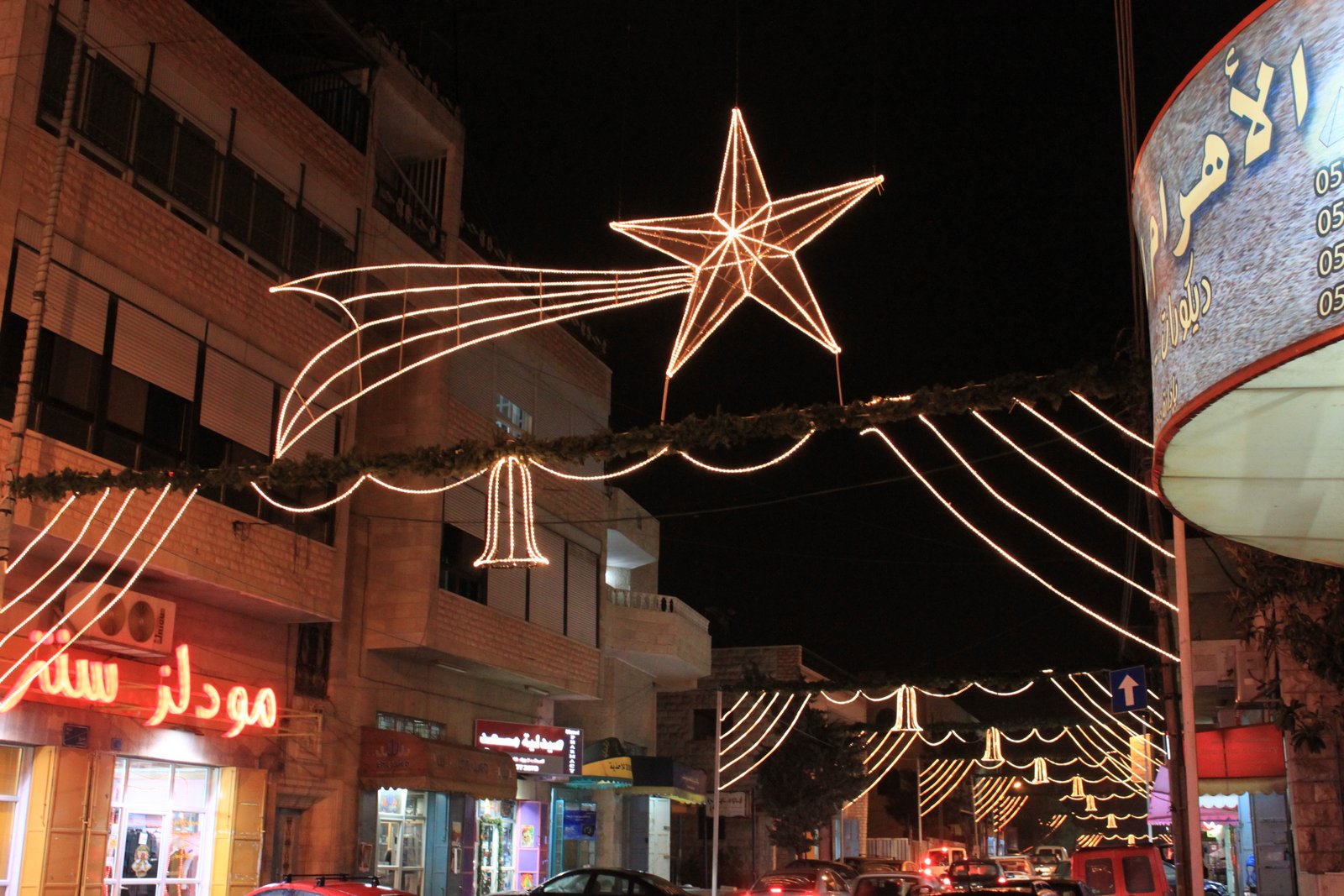
And naturally, I had to throw in a picture of the Beit Sahour Christmas tree!


After a quick visit to Nativity Square (mostly to say that I had gone, like the thousands of people who come from all over the world to be there Christmas Eve) I walked home. And as it started to rain I saw, could it be, Santa! riding in a car and waving at everyone. Sahar told me that you can hire him out to come to your house and deliver presents to the children. Awesome.

Saturday, September 10, 2011

"Help from both sides of the veil"

In one of his BYU devotionals, Elder Holland tells the story about an 18-year-old from a small town in Southern Utah that left home to travel east to visit his sister. He was taking the train and he had an overnight layover (what do you call a train layover?) in Chicago, and it terrified him. However, Elder Holland relates, when his parents drop him off at the train station, "his humble, plain, sun-scarred father did something no one in this room should ever forget. He said, 'Son, wherever you go in this Church there will always be somebody to stand by you. That’s part of what it means to be a Latter-day Saint.' And then he stuffed into the pocket of his calico shirt the name of a bishop he had taken the time to identify from sources at Church headquarters. If the boy had troubles, or became discouraged and afraid, he was to call the bishop and ask for help."

Well, the boy did have troubles in Chicago and did call the bishop and did get help. And that story has always stuck with me. Wherever I go in the world, if there are Latter-day Saints anywhere nearby, I know that there will be someone to stand by me.

Later in the talk, Elder Holland gave this epic statement: "In the gospel of Jesus Christ you have help from both sides of the veil, and you must never forget that. When disappointment and discouragement strike—and they will—you remember and never forget that if our eyes could be opened we would see horses and chariots of fire as far as the eye can see riding at reckless speed to come to our protection. They will always be there, these armies of heaven, in defense of Abraham’s seed."

And today I want to talk about help from both sides of the veil.

The auditorium of the Jerusalem Center, where church is held. District Conference filled almost all of those seats, including the 88 BYU students that are here on study abroad and live at the Jerusalem Center. And don't be jealous, but the chapel here has the most beautiful view in the church (although you can't see it in this picture--this overlooks the Old City, the Garden of Gethsemane, the Kidron Valley, etc), with the view out the window of the Galilee branch building (which overlooks the Sea of Galilee) coming in as a close second.
Today we had District Conference in Jerusalem, with members of all three branches in Israel (Tel Aviv, Galilee, and Jerusalem) participating. And I was reminded once again that no matter where you are from or what language you speak or what you are doing in life, there is a place for you in the gospel of Jesus Christ. From the three branches in Israel, we had Spanish, Russian, Arabic, Tagalog, and English speakers. The program was translated into four languages. Headsets were handed out before the meeting started and local members worked as translators so that everyone could hear the message in a language they understand.

This is help from our side of the veil.

But sometimes translation of the words is not the only thing needed. I believe that the Spirit is necessary to translate what the speaker or the scripture or the song says to what we personally need to take from it.

As we sang the opening song today in District Conference, I had one of those translation moments. I'll admit it straight up: moving to Jerusalem for a year of graduate studies was not the easiest decision in the world to make for so many reasons. Even after coming out here the doubts still occasionally surface. Questions of money, safety, purpose, and ability often hamper my ability to move forward with what God has asked me to do. But today's opening song, just a week after I arrived in Israel, was "How Firm a Foundation."

Each time I have questioned my decision to go to Israel (starting back in 2005), this hymn has come up in sacrament meeting, a BYU devotional, sung as part of our repertoire in Women's Chorus, or as a General Conference hymn. The second verse always hits me the hardest: "In every condition, in sickness, in health, in poverty's vail or abounding in wealth, at home or abroad, on the land or the sea, as thy days may demand so thy succor shall be."

I have found this to be true. According to what our lives demand, God succors and helps us. And often it is through help from our side of the veil.

Let me tell you two stories to illustrate.

When I first got to Jerusalem I didn't have an apartment lined up. I wanted to be able to look at them and meet the roommates before agreeing to anything, which was great. It just left me homeless for a couple of days while I found a place to live. My kind friend (whom I had never before met but had emailed her two days before I arrived. She is Mormon and graduated from BYU, and because we shared these two factors she offered to let me stay at her apartment for as long as I needed) had let me sleep on her floor. This was miracle #1. A week later, when I found an apartment, I needed to find a way to cart my luggage across town. I considered the bus but I wasn't sure if they would be ok with me and 3 suitcases. I thought about a taxi but didn't really want to pay that much money just to cart my suitcases across town.

And then I remembered. I'm a member of the Church of Jesus Christ of Latter-day Saints, and there are people here who can help me. I emailed my Relief Society president (I don't have a phone yet) and asked her if she knew of someone who could give me and my suitcases a ride to my new apartment. And boom. Within 4 hours I had a ride arranged for the next day.

When my Relief Society president found out that my housing situation is only temporary and I will be looking for another apartment come October 17, she said, Oh, I think the Walkers were looking for someone to housesit and watch their dog in October. And boom. Within 4 hours I had arranged with the Walkers to stay at their house for the three weeks they will be in the US, providing me with housing until November 19.

There are several points to my story. First, my Relief Society president is an absolute angel and so willing to help anyone in need. Second, members of The Church of Jesus Christ of Latter-day Saints all over the world are willing to help and serve when others need a hand (or 20!).

And third, in the gospel of Jesus Christ you have help from both sides of the veil. And today helped me see those armies of heaven riding at reckless (I love that word) speed to my protection and aid.

Isn't God wonderful?

Sunday, September 4, 2011

First Day of Class

Naturally, I am behind on my blog. I still need to write a trip about my exciting adventures on the way to Israel. Don't worry--pictures of London and stories of intrigue and adventure (as well as all those DC posts!) are coming.

But I just finished my first day of classes (I have class Sunday-Thursday, Friday is like Saturday, and Saturday is the Sabbath here in Jerusalem), and naturally I feel the need to record some thoughts I have about studying intensive Hebrew in Jerusalem.

*I feel so old here. I am in one of the lower levels of Hebrew, along with recent high school graduates and those who haven't yet finished high school. I thought I would be safer by attending an ulpan in September, after school started, but I forgot that the school year starts at different times around the world. I thought maybe I was just being judgmental when I walked through the hall and thought that everyone looked like they were in junior high, but then I found out that one of the guys in my class is 14. 14!!  The rest are 18 or 19, but that doesn't make me feel much better. I'm not ready to go back to high school!

*I have long wondered how to handle harassment in the Middle East. I don't really get harassed in the States, so I never struggled with how to handle it there. But in the Middle East it is almost a given. When I lived in Jerusalem the first time it shocked me. When I lived in Jordan it angered me immensely. I felt proud that I restrained myself and never attacked anyone--I just ignored them unless it was really bad, and then I gave them "the look" (that said, you look at me one more time and I will break your nose. It worked every time). But this time I think I have figured out a solution. Instead of just ignoring them, I think I'm going to call them out on it. Like today, when these two guys were walking next to me in the hall of the university and started harassing me (in English). I'm not so used to native-sounding English harassment (I don't think they were Americans though) and, not knowing what to do, I just ignored them. But if it happens again, I think I'm going to turn to them and say, "Is that really necessary? What are you trying to pull?" or something equally brilliant. I'll let you guys know how it goes.

*I did pretty well in my class, considering that I have never actually taken a Modern Hebrew class and it was all in Hebrew. (I asked if I could test into a higher level because of my Biblical Hebrew and Arabic background and then studied every day on the Metro to get into a higher class. If I didn't, I would have to repeat the level in the Fall, and I really didn't want to do that!) My main problem is speaking, seeing as how I have never spoken Hebrew before. Today was a struggle and I thought about calling it quits (or at least dropping to a lower class level). But I just kept reminding myself that for the first day ever in a Hebrew class, I was doing pretty well!

*I have class for only 5 hours a day, so I was expecting a ton of homework. But I asked the teacher how much to expect, and she said she assigns 30 minutes to an hour each day! This was a shocker to me, since when I took intensive Arabic we did 4 hours of class and 8 hours of homework a day (and I was working 4 hours a day too!). I guess I will have to find a way to fill up all the extra time with my own homework!

*I am studying at the "Rothberg International School" at Hebrew University. Which means that students have come from all over the world to learn Hebrew here. My teacher was shocked because there are 10 Americans in my class. "10 Americans! We should call this the 'American class'! Why are there so many Americans?" The others in my class are from France, Germany, Italy, Russia, Mexico, and then a few Arabs from Jerusalem.

*My roommate (who is kindly letting me sleep on her floor while I search for an apartment) said that I should make a "Chinese-Arabic-Hebrew only" vow while I am here. It sounds a little overwhelming, but yesterday I was typing Hebrew and emailing my friend in Chinese and reading Arabic--all within one hour. My goal for this year is to increase my skills in all three languages. Does anyone think I can do it (without going crazy from the effort)?

*The littlest things have made me really happy here. Like flushing toilets, and drinking fountains, and soap and toilet paper in public bathrooms, and stores (and vending machines!) that take credit cards. It is such a contrast to my last university-in-the-Middle-East experience, and each time I see an amenity like this I get a little bit giddy. "I don't have to buy my own toilet paper? What a dream!"

*I found myself studying in the Asian Studies section of the library today. It's a strange feeling to feel comforted surrounded by Chinese books at an Israeli university...

*I was walking out of my apartment (aka the dorm room at which which my new-found friend is kindly letting me crash until I find a real apartment) the first day I got to Jerusalem and this man gave me a flyer and asked (in English) "Are you a graduate student?" When I responded in the affirmative he said, "I could tell. Where did you do your undergrad?" When I answered "BYU," he almost fell over with excitement. "Are you Mormon? I know lots of Mormons! Do you sing with the choir? I know people in the Mormon choir! There's this black guy..." "Alex Boye?" "Yeah, yeah! I know Alex Boye!"

He then proceeded to pull out his phone and prove to me that he knew several people in the choir because they were in his phone. He was shocked when I didn't know any of the several people he just named. "But they live in Salt Lake! Don't you go to church?"

I had to remind him that there are hundreds of thousands of Mormons in Utah, and there was no way I could know each one. Even after all this, he asked, "Should I tell my friends that I met you?" and asked me to tell them hi next time I see them.

Ok. Next time I see Alex Boye, I'll tell him hello from the man in Jerusalem.

Well, friends, more will come, but my first impressions are that I'm crazy, that studying Hebrew and Arabic at the same time just might kill me, and Hebrew University has a pretty nice campus. And just as a last bit of randomness-I ate a cucumber, tomato, and goat cheese sandwich today, and it was delicious. I've missed Israeli kosher sandwiches.

Saturday, July 30, 2011

Mormon Tabernacle Choir Concert


One of the best things about living in Utah that I didn't fully appreciate when I lived there was the vast abundance of free high-quality musical performances. Living in DC is also great in this respect, but when I heard that the Mormon Tabernacle Choir was coming out here to perform 30 minutes away from where I live and tickets were $20 for the cheapest lawn seats, I thought, "No way am I going to pay $20 to hear the Choir when I used to listen to them all the time in Utah for free."

Well, someone had pity on me and others like me and my ward got about 100 free tickets to the Choir concert. And it was absolutely spectacular.

I feel incredibly lucky to have grown up with the Mormon Tabernacle Choir. For lots of people at the concert, it was the first time they had ever seen the choir live. And even with tickets ranging from $20-$60, the place was packed.
As usual, the Tabernacle Choir did not disappoint. And with good friends and a beautiful sunset (and 95 degree weather with unbearable humidity, which only added to the thrill of it all), what could be better?

On the bus on the way home after the concert I was listening to the conversations going on around me. Actually, there was just one conversation, between three very loud men on the bus. And they were talking about how weird Mormons are, even if the Tabernacle Choir is spectacular. "They don't drink coffee--and they change the words in songs from 'coffee' to 'cider!'" said one of them.

"Yeah," said another. "I was in a hotel in Salt Lake once and they didn't have any alcohol in the fridge in the room."

During their whole 20 minute conversation I was snickering silently to myself. I wanted to see the looks on their faces when I stood up and casually mentioned that I was Mormon. But, unfortunately, I never got the chance. And I figure, if the only reason people think we are weird is because of the Word of Wisdom, I think that's pretty good!

Thursday, July 7, 2011

The Plan of Salvation...on Pennsylvania Avenue


Looks like the missionaries have been out sidewalk-chalking! This was on the side of Pennsylvania Avenue. I walked past it on my way home from work and just happened to have my camera with me to catch this moment and share it with all of you. More about the Plan of Salvation here.

Monday, April 11, 2011

These Things Are Never Ok

I usually try to keep my blog material light and funny (thus hiding my true personality). However, this weekend I had an experience that quite upset me, actually, and thus the nature of this not-funny and not-light blog post. If you are the type that reads this blog just to laugh, skip this post and come back another day.

I want to address the issue of "these things are never ok: never say these things about or to your spouse in public." Now, I am not married, but I still know what type of comments could potentially signal "the beginning of the end." I have one tip for a happy marriage: never insult your spouse in public, even in jest, and never joke about leaving your spouse or finding another spouse. These, my friends, are comments that wreak havoc upon personal emotions and relationships.

What event could make me so passionately aware of this issue? I was riding in a car with some friends, including a married couple. I don't know the man very well (we are in a class together) and I had just met the wife. After hearing about some of my academic feats (I think it was somewhere between stating that I had 2 majors and 2 minors and I have TA'ed for 23 classes), the man turned to me and said, "Now Breanne, if things don't work out between my wife and I..." implying that things could work out between he and I. My anger and emergency systems immediately went on alert and, while trying to handle the situation as tactfully as possible, I suggested that it was already a little too late for that (and his wife stated, "But things have already worked out between us...it's a lot too late"). While the man was still laughing, thinking, I am sure, that it was a great joke, his wife said, "Why are we laughing about this? Am I supposed to think this is funny?" She was laughing also, but her words betrayed her possible hurt. I, on the other hand, was offended that I had been brought into and become the object of a discussion about the relationship of the man and his wife.

I didn't go off on a rant in the car. It is not my place to counsel individuals about their relationships and what they say in public. However, I think the mood in the car, while still laughing, made it clear that things like that were not ok to say (I did make some comment about how if it had been my husband that said that, "There would be h*** to pay tonight!"). Please, men, if you love your wives, don't ever insinuate that things won't work out between the two of you in public. And if you don't love your wife, don't say anything about her in public either. Things like these can become a hidden wedge that starts to tear marriages apart. Your wife is worth more than that. You are worth more than that. And  your current and future relationship is worth more than that.

I will finish this post with a story shared in the April 2011 General Conference by Richard G. Scott entitled "The Eternal Blessings of Marriage:"

"I remember one day I took some of those little round paper circles that form when you punch holes in paper, and I wrote on them the numbers 1 to 100. I turned each over and wrote her a message, one word on each circle. Then I scooped them up and put them in an envelope. I thought she would get a good laugh.


"When she passed away, I found in her private things how much she appreciated the simple messages that we shared with each other. I noted that she had carefully pasted every one of those circles on a piece of paper. She not only kept my notes to her, but she protected them with plastic coverings as if they were a valuable treasure. There is only one that she didn’t put with the others. It is still behind the glass in our kitchen clock. It reads, 'Jeanene, it is time to tell you I love you.' It remains there and reminds me of that exceptional daughter of Father in Heaven.


"As I have thought back over our life together, I realize how blessed we’ve been. We have not had arguments in our home or unkind words between us. Now I realize that blessing came because of her. It resulted from her willingness to give, to share, and to never think of herself. In our later life together, I tried to emulate her example. I suggest that as husband and wife you do the same in your home."

Sunday, April 3, 2011

General Conference Favorites

General Conference was this weekend. For those who don't know, General Conference is held twice a year and is a time when the leaders of The Church of Jesus Christ of Latter-day Saints speak to the members and everyone else throughout the world that would like to listen. The proceedings are available on radio, tv, and internet, and the live meeting is in Salt Lake City. 5 2-hour conference sessions are held over the two-day period, and General Conference is always highly anticipated by members of the church.

Anyway, I started thinking about a few conference talks that have highly impacted my life, both at the time they were given and for years afterward. I thought I would give you a short list of 10 of the talks that have most impacted my life (there are many more than 10, though!). I have only included those talks that I remember being given live...although many talks before my time have also greatly impacted me, that will have to be a post for another day. So, in order by the year they were given, the talks:

1. October 2003, Anne C. Pingree: "Seeing the Promises Afar Off"
This one most impressed me because of the story she told about the African women who walked 18 miles to get a temple recommend that they might not ever get to use. "As they walked with faith in every footstep along that sandy jungle trail in West Africa, those valiant Nigerian sisters could not have imagined that the walls of a holy temple of God would one day rise in their own nation. They could not have imagined that the inspired words of another prophet of God, President Gordon B. Hinckley, would bring the promised blessings they hoped for and had seen 'afar off.' They only knew that the Lord restored His gospel in these times, that a testimony of that gospel burned in their hearts, that faith lit their way in life. Then they acted on a prophet's counsel to be worthy and to carry a temple recommend."

2. April 2004, Dennis E. Simmons: "But If Not..."
This was during a difficult time in my life when I felt like promised blessings were not being fulfilled. "Our scriptures and our history are replete with accounts of God's great men and women who believed that He would deliver them, but if not, they demonstrated that they would trust and be true."

3. April 2004, Bruce C. Hafen: "The Atonement: All For All"
I read this talk maybe 100+ times. "Almost is especially enough when our own sacrifices somehow echo the Savior's sacrifice, however imperfect we are. We cannot really feel charity--Christ's love for others--without at least tasting His suffering for others, because the joy and the suffering are but two sides of a single reality. When we really are afflicted in the affliction s of other people, we may enter "the fellowship of his sufferings" enough to become joint-heirs with Him."

4. April 2005, David A. Bednar: "The Tender Mercies of the Lord"
This talk helped me to recognize and give voice to things I had already seen that the Lord had done for me. "A Loving Savior was sending me a most personal and timely message of comfort and reassurance through a hymn selected weeks previously. Some may count this experience as simply a nice coincidence, but I testify that the tender mercies of the Lord are real and that they do not occur randomly or merely by coincidence. Often, the Lord's timing of His tender mercies helps us to both discern and acknowledge them."

5. April 2006, Jeffrey R. Holland: "Broken Things to Mend"
As might be apparent, I am a huge fan of Elder Holland's talks. I am slightly biased because he, too, was an English major at BYU, and his command of the English language is stellar. I have memorized many of his devotionals given at BYU over the years, and I was pleasantly surprised to hear many of those favorite devotional quotations used in this talk. I knew what he was going to say before he even said it, and that was very exciting. "My desire today is for all of us--not just thos we are 'poor in spirit' but all of us--to have more straightforward personal experience with the Savior's example. Sometimes we seek heaven too obliquely, focusing on programs or history or the experience of others. Those are important but not as important as personal experience, true discipleship, and the strength that comes from experiencing firsthand the majesty of His touch."

6. October 2006, Jeffrey R. Holland: "Prophets in the Land Again"
Wow. This talk was such a thrill. Just imagine! We proclaim to all the world that God speaks to prophets on the earth today. He has not forgotten His people, nor will He ever! "It is no trivial matter for this Church to declare to the world prophecy, seership, and revelation, but we do declare it. It is true light shining in a dark world, and it shines from these proceedings."

7. April 2007, Jeffrey R. Holland: "The Tongue of Angels"
I have always had a problem with being just a little too sarcastic. At this particular time in my life I was living in Jerusalem and not always realizing the effects of my verbal tongue lashings I gave to fellow students and teachers (even if I felt they deserved it!). Ever since this talk, I have tempered my tongue immensely. "So, brothers and sisters, in this long eternal quest to be more like our Savior, may we try to be 'perfect' men and women in at least this one way now--by offending not in word, or more positively put, by speaking with a new tongue, the tongue of angels. Our words, like our deeds, should be filled with faith and hope and charity, the three great Christian imperatives so desperately needed in the world today. With such words, spoken under the influence of the Spirit, tears can be dried, hearts can be healed, lives can be elevated, hope can return, confidence can prevail."

8. April 2007, James E. Faust: "The Healing Power of Forgiveness"
I was overwhelmed by the love and forgiveness of the Amish community. Would I respond in a similar manner to such a tragedy? I hope so. "When tragedy strikes, we should not respond by seeking personal revenge but rather let justice take its course and then let go. It is not easy to let go and empty our hearts of festering resentment. The Savior has offered to all of us a precious peace through His Atonement, but this can come only as we are willing to cast out negative feelings of anger, spite, or revenge."

9. April 2008, Thomas S. Monson: "Looking Back and Moving Forward"
This was given right before I went to Jordan for a semester. I put it on my ipod in Arabic and in English, and during the many sleepless nights I had there, I would lie in my bed listening to this talk, over and over. For some reason hearing President Monson's voice and his words about God's dealings with man throughout history did much to calm and heal my broken and aching heart. "Mortality is a period of testing, a time to prove ourselves worthy to return to the presence of our Heavenly Father. In order to be tested, we must sometimes face challenges and difficulties. At times there appears to be no light at the tunnel's end--no dawn to break the night's darkness. We feel surrounded by the pain of broken hearts, the disappointment of shattered dreams, and the despair of vanished hopes. We join in uttering the biblical plea, 'Is there no balm in Gilead?' We are inclined to view our own personal misfortunes through the distorted prism of pessimism. We feel abandoned, heartbroken, alone. If you find yourself in such a situation, I plead with you to turn to our Heavenly Father in faith. He will lift you and guide you. He will not always take your afflictions from you, but He will comfort and lead you with love through whatever storm you face."

10. October 2008, Joseph B. Wirthlin: "Come What May and Love It"
This was a classic. I was on my mission. There are a lot of things on missions that are really difficult to love. Heat, humidity, cockroaches, riding bikes, constant rain or beating sun, companions, people who don't come to appointments, and other difficulties sometimes make you feel guilty because you don't love every second of the mission. I loved what he said: "How can we love days that are filled with sorrow? We can't--at least not in the moment. I don't think my mother was suggesting that we suppress discouragement or deny the reality of pain. I don't think she was suggesting that we smother unpleasant truths beneath a cloak of pretended happiness. But I do believe that the way we react to adversity can be a major factor in how happy and successful we can be in life."

And as a bonus: October 2008, Jeffrey R. Holland: "The Ministry of Angels"
I had been studying angels in the scriptures for several months. I desperately needed to know that as a missionary, I could do the work of angels. And then Elder Holland gave this talk. I felt like God was speaking directly to me. "Breanne, this talk is for you": "Usually such beings are not seen. Sometimes they are. But seen or unseen they are always near. Sometimes their assignments are very grand and  have significance for the whole world. Sometimes the messages are more private. Occasionally the angelic purpose is to warn. But most often it is to comfort, to provide some form of merciful attention, guidance in difficult times."

What are some of your favorite Conference talks through the years?