Showing posts with label Bethlehem. Show all posts

Thursday, July 26, 2012

Temperature Extremes

I'm back in Utah now, and it's been hot. Really hot. The fact that my recently-purchased car doesn't have working a/c only adds to the misery.

And every day, I think to myself, "I'm so glad that I'm not in the Middle East anymore!"

When I lived in Jordan, it was HOT. I slept with the fan on full blast pointed at my face all night, and the lack of air conditioning everywhere made things miserable. 

When I lived in Taiwan, it was HOT in the summer. I was riding my bike several hours a day and sitting in hot houses and dripping sweat like there was no tomorrow. But I always had an air conditioning unit in my room, which was a lifesaver. In the winter, it was COLD. The only heaters we had were small non-blowing space heaters, and everything was made of tile. And everything was WET all the time. It rained all the time, so my shoes, my clothes, my hair, my body, my floor--everything was just wet and cold.

Because of my two prior experiences abroad, I thought I would be fine in a non-insulated, non-heated/air conditioned apartment in the West Bank.

But I thought wrong.

I was shocked at the temperature extremes I experienced this past year. Remember my apartment? The small thing with 15-foot high ceilings, no insulation, and a tile floor? The first night I moved in, I looked at the bedspread on the bed and thought, "I'd rather not touch that until I wash it." Plus, I never ever sleep under the covers, Often in the winters in Utah I open my window at night because I get too hot with my blanket on (because of the heaters).

So I laid a sheet down and laid on top of the heavy covers. Finally, about 2:30 am and after waking up at least every 30 minutes shivering, I thought to myself, "I am really going to die. There is no way I am making it through the night. They will have to drag my frozen body away when they find it in a few days, because I am freezing to death." I finally realized that I could put an end to all this suffering and sleep under the covers. It was such a novel idea to me that I hadn't even thought about it before. 

But that's how cold it was. Remember the distance from my couch to the stove?


During the winter I had a small, non-blowing space heater (the kind that gives you second-degree burns on your left leg as your right leg still has ice encrusted to it) placed next to my legs as I sat on the couch. And it was so cold that most nights I didn't want to leave the heater and walk over to the stove because my jean-clad legs would freeze on the way there. Each night I boiled water for my hot water bottle. I would walk over to the sink, fill up the pot, put it on the stove, and walk (run) back over to the heater. When the water started boiling, I would pour it in my hot water bottle and run it to my bed (to warm it up) and then run back to the heater. And that was about all the time I spent away from the heater until I went to bed. 

It was so cold that some mornings I woke up with burns on my arm from the rubber hot water bottle. And I had still been freezing during the night (even sleeping under the heavy covers!!).

My sister, standing by the gas stove trying to get warm after the electricity went out
My one consolation was that since my apartment was 10 degrees colder than the outside air (more when it rained) in the winter, it HAD to be cool in the summer.

Good thing I didn't know the truth, or I might not have survived the winter. After the customary 3 weeks in March of pleasant weather, where everything turns green and blooms and it looks like a beautiful country, the weather started getting HOT. And I found out about an unhappy reality: my apartment was 10 degrees hotter than the outside air in the summer (more when the sun was shining).

Although most Arab homes and apartments are built without air conditioning (at least in the West Bank and Jordan--electricity is way too expensive and Bedouin are used to living in tents anyway, right?), they usually put the windows in a way that creates an air tunnel (to air your house out and allow a breeze to blow through). Not so with my apartment. The three windows were placed in three different rooms with little opportunity for air flow.

It was so hot that I removed everything but a thin sheet from my mattress so that my body didn't have to come into contact with more fabric than necessary. It was so hot that I would sit on my couch with the fan pointed straight at me and would rarely leave, even to walk over to the fridge to get something to eat, because I would start dripping sweat as soon as I walked away from the fan. 

It was so hot that I would wake up several times a night, go to the sink, and dump cold water all over my body to try and cool off. Sometimes I just cried because I was so hot. And the tears were hot, too. It was so hot that one day I scraped all the ice out of my freezer and rubbed it all over my body. And then went and sat by the fan.

I think you get my point. It was SO COLD in the winter and SO HOT in the summer. Thank goodness my car doesn't have a/c so I don't miss the heat too much...

Tuesday, June 26, 2012

Bethlehem University

So I'm actually in Turkey now, but I have several posts that I want to finish. And it just won't be the same thing when I get back. So I'll post about my trek through Europe later.

Today's post is about Bethlehem University. Somewhere in the middle of my less-than-wonderful Arabic experience at Hebrew University, I realized that I could waste my money going to classes in English that weren't going to count for anything, or I could spend my money on a bunch of random classes in different languages all over that wouldn't count for anything. Can you guess what I decided to do? The second semester of my time at Hebrew University I dropped to half-time, took only 3 classes (all in Hebrew) at the university, and then took a class at Bethlehem University, one at the Polis Institute, an intensive Hebrew course at Ulpan Or (more to come about that later), and in addition to my internship at ICCI, I travelled to several different places in the West Bank to conduct research.

It was, to say the least, much, much better than wasting my money on classes in English with Americans like I did my first semester.

Classes at Bethlehem University and classes at Hebrew University were completely different. The whole atmosphere was different. The only things that overlapped, I think, was the smoking and, well, probably the smoking.

While most students at Hebrew University are between the ages of 22-30 (because of the army, travel, and other things Israelis do before going to college), most students were 22 or younger at Bethlehem University. It actually reminded me a lot of the University of Jordan, but on a much smaller scale. Bethlehem University is a Catholic university, and the only Christian-run and -funded university in the West Bank. (But Muslims are welcome and make up more than 50% of the student body.) It is quite a small campus in Bethlehem, with several buildings and large outdoor areas where students can sit and chat.

Did I mention that in both the University of Jordan and Bethlehem University, the students like to sit and chat? Like for hours?

I decided to take a class here for several reasons. First of all, I wanted to improve my Arabic by listening to lectures in Arabic. Secondly, I was intensely curious to see how a Christian-Palestinian university and a Jewish-Israeli university differ. And third (and this is perhaps the most important), I wanted to be surrounded by students who like to sit and talk. Because I wasn't speaking Arabic enough every day. And all of those students were just sitting there, waiting for me to go up and talk to them.

My class was interesting enough--it was an introduction to Islam and Christianity, with half the class about Islam and taught by a Muslim teacher, while the other half on Christianity was taught by a Christian teacher. I mostly just sat in class and tried not to make waves. I was thrilled to realize halfway through the semester that I could finally understand what the teacher was saying, but I'm sure that had a lot more to do with subject matter than my Arabic ability improving! (The Christianity half was the second half...)

My classroom
However, what really changed my life and my experience this past year was what I did each Thursday and Friday before class. I bit the bullet and went out into the courtyards to talk to the female students sitting around chatting.

To understand what a feat this was for me, you have to understand how I felt about junior high. I hated junior high. Absolutely hated it. Walking down the halls, it was like everyone was judging you because you weren't popular enough or your clothes weren't fancy or you walked funny or you were just different. It seems like junior high is a time to fall down the stairs in the hall and forget where your classroom is and sit alone in a corner at lunchtime trying to eat as fast as you could. And the worst thing about junior high was the GOSSIP. Or maybe the fact that friends were your best friends one day and your worst enemies the next (and the next and the next).

Now, Arab universities and American junior highs are very different places. But when I walked around the campuses of the University of Jordan and Bethlehem University, I felt like I was in junior high again. Those same feelings of are people looking at me? Why is everyone staring at me? Can I just sit in the back of the classroom and not say anything? Where's a bathroom that I can hide in? Why do students sit around every door into the building? Can't I just walk for five minutes without having to walk past people? plagued me every day. Especially because I'm a foreigner and I walk around alone. I always felt like people were staring at me (not just at the university, but all the time actually!).

But, I moved to the West Bank so that I could improve my Arabic, and I had to talk to people if I wanted to improve my Arabic. So with a lot of help from Elad and my Arabic class, I would walk on campus, see the throngs of people sitting around talking, walk into a building and find a bathroom, take deep breaths and remind myself how much I needed to speak Arabic, go back outside, walk around campus looking for my next victims, and then walk up to them and strike.

"Hi, I'm Breanne and I'm studying Palestinian accents," I'd say (which is true). "Do you mind if I ask you some questions and record your answers?" They were almost all totally willing and excited to talk to me about Palestinian weddings, Islam, the university, the relationship between Muslims and Christians, etc. So I would talk to them for 15-30 minutes, recording the conversation, and then thank them and leave.

It sounds easy, but it was, for reasons beyond my understanding, incredibly difficult for me. Perhaps because I was in a position of disadvantage (because I don't speak Arabic perfectly and I was the foreigner and I was asking them for help), but it was really hard to do this each week. Plus, I had to find the perfect people to talk to: no less than two girls and no more than three (otherwise it's overwhelming to them or to me), no boys could be with the group, they couldn't be too close to the fountain or other loud noises, and as the summer wore on they had to be in the shade since it was way too hot in the sun.

And guess what? I only chickened out a couple of times. Most days that I went to class I found at least one group of girls to talk to. And it was always a good experience. You'd think that it would get easier because of all the good experiences I had, but guess what? It was still pretty hard.

The most important thing, however, was that I recorded lots of conversations in colloquial Arabic about lots and lots of different topics, and lots of the same topics, and it gave me the courage to work on my graduate research interviewing women from all over the West Bank.

And yep, my Arabic improved a lot. So I guess it was all worth it. And I'd probably even do it again if I had to!

Friday, May 11, 2012

Checkpoints

I'm sure that my faithful blog readers have been dying to know what it's like for me to pass through a military checkpoint every day. What, exactly, does one do when passing through a military checkpoint? (And why would someone ever choose to do it every day?) I am quite aware that this could turn into a controversial political conversation about the need for checkpoints or the need for a separation barrier or the suffering of the Palestinians, etc. etc. Personally, checkpoints are not my favorite place in the world to hang out, and some days I feel that each checkpoint crossing takes another 6 months off of my life. Some days I get so angry that it takes me several hours to recover from the crossing. But, let's try to keep this post light, shall we? You don't all need to know about my anger problems or anything else. This, hopefully, will be an educational post to give you an idea of what checkpoints are like. And while there are many checkpoints between the West Bank and Israeli territory, as well as within the West Bank itself, I will focus on the Bethlehem 300 (Rachel's Tomb) checkpoint.

This is a (very) rough sketch of the Bethlehem checkpoint. I know, my Paint skills are incredible. I kept it this unprofessional just in case I really am being spied on. There's no way that anyone could accuse me of passing along dangerous information with this drawing. :) (Just for reference, the dark boxes are soldier's booths, the x's are turnstiles, and the arrows are directions of traffic. The numbered areas are different smaller checkpoints within the checkpoint.)

When approaching the checkpoint from the Bethlehem side, this is what you see:

There is a big wall and a long line stretching about 100 meters. I'm not really sure how to describe the path that you walk down--I always call it "the cattle stalls" because I feel a bit like an animal being contained in a holding pen until I can cross checkpoint #1 (labeled on my drawing).


Here is a view of the inside of the middle "stall." I thought the smoke made for a dramatic touch photographically, and it also adds a nice picture of reality. When you're stuck in line here and 40% of the men are smoking, or even just one person who is standing in your close vicinity, there's no way to escape. Many days I have arrived to the university smelling like I, myself, smoked 6 packs just that morning.

There are three "lanes" or stalls or whatever leading up to the checkpoint #1. I have labelled them with arrows that signify which direction they go: the one closest to the wall is for those coming in to Bethlehem, while the two outer ones are for those leaving to go into Jerusalem.

When the checkpoint is crowded (mostly early in the morning), the men use the middle lane and women, children, old people, sick people on their way to the hospital, and tourists use the "express" lane. Many mornings when I have crossed I have seen the line of men (2-3 across within the lane) stretching all the way back to the taxi area. On those days, I'm so glad that I can use the lane for women.

Of course, there are no signs telling you if the middle lane is crowded with men or is open (it's impossible to see all the way in from the entrance by the taxis) and there is also no sign at the bottom telling you if the women/elderly/tourist lane is open or not. There are turnstiles at the top (the x's on the diagram), and if they aren't open (they are controlled by the soldiers who sit in the blue boxes on the diagram--every dark box is a station where soldiers sit), you have to wait until the soldier unlocks it for you. Some days, for reasons beyond my imagination, they decide not to open the women/elderly/tourist checkpoint. Which is always frustrating because I usually find that out after walking all the way up. As there is no way to cross from the tourist lane into the middle lane at the top, I have to walk all the way back down to the bottom and then back up through the middle lane. On rainy days this inspires less than happy thoughts from me.

On days that the women/elderly lane (I will call this lane #3) is closed because the middle lane is open and free, you just walk up the middle lane, pass through checkpoint #1, and continue to the next one. However, some days lane #3 is closed but there are still lots and lots of men filling lane #2. Thankfully, it doesn't happen that often, but when it does there is a "rule of chivalry" that states that women get to pass through to the front of the line. Although I'm sure not every man is thrilled with this "rule," if there are women standing at the back of the line the sea of men will part and allow the women to pass through. If some men don't see (or don't want to move) and the women (there are usually only 1-4 at a time) have to stop, a man standing by will always shout, "Clear the way, guys, we have some women coming through." It is always incredibly embarrassing and incredibly gratifying at the same time. I will be the first to admit that there are a lot of problems regarding the treatment of women in the Middle East. But this idea that women should not have to wait in line with hundreds of men but instead should cut to the front is an awesome one, in my opinion. And although I was terrified the first time I had to pass through a narrow space surrounded by hundreds of men, knowing how vulnerable I was, they always press themselves against the side and try to give us as much space as possible so we can pass through without touching anyone or being touched.

When you get to checkpoint #1, there is a soldier sitting in a booth (don't worry, it's completely enclosed and bullet-proof, giving as little contact as possible with those passing through) to whom you show your id/passport. This is more of a "just checking to make sure you have it before you go through to the next stations" kind of checkpoint. And if it's possible to have a favorite checkpoint soldier, there is a soldier who is often at this checkpoint in the morning that is my favorite. He speaks Arabic (most of the soldiers don't) and stands outside of the booth checking ids. He greets the people coming through (in Arabic) and is usually smiling. And whenever I go through he says "morning," in English, all nice and pleasant like. 

After checkpoint number one, you walk across an empty parking lot and enter building #2.


You walk down some more lanes and enter the area of checkpoint #2. Checkpoint #2's area is divided into three different checkpoints, all of which lead to the same place. Here, again, when there are lots of men in the morning, the women duck through separator bars and cut to the front of the lines. The men step back and clear the way for the women (usually just one or two in each line at a time--mostly men cross early in the morning), which, again, is great and saves me so much time and frustration.

Usually, the wait time at the turnstile at checkpoint #2 is short and predictable. The soldiers (who can't be seen from the line waiting outside the turnstile, as they sit in the booths inside; don't worry, they can see everything going on because there are cameras everywhere) open the turnstile, let three people through, and then lock it while they put their stuff on a conveyor belt scanner and pass through a metal detector, grab their stuff, and proceed to checkpoint #3. If there are any problems, the soldiers get on the loudspeaker from inside the booth and tell the person to go through again, take the belt off, it's the shoes, etc. Sometimes they even do it in Arabic, although I think most of them only know a few key phrases ("one at a time!" seems to be the most popular Arabic phrase spoken here).

Sometimes, however, for reasons that none of us are made aware of, there is a wait at checkpoint #2. Maybe the soldiers are switching posts. Maybe they need a bathroom break. Maybe they are just tired of sitting there and need to walk around. But whatever the reasoning, they don't say anything. They just keep the turnstile locked, and all of us outside the turnstile get more and more restless. If this were a customer service situation, I would suggest that they announce over the loudspeaker that there will be a delay of about 10 minutes and they apologize for the inconvenience. But it's not a customer service situation, it's a military checkpoint, so I guess such a suggestion is unnecessary.

Once you get through checkpoint #2, you proceed to checkpoint #3. This checkpoint has the least delays. The Palestinians have a magnetic id and a paper permit that shows that they are allowed to cross into Jerusalem. They put their id on the magnetic strip, hold up their paper to the window (the soldiers are sitting in booths), and sometimes have to put their hand on the fingerprint reader. The magnetic card reader allows all of the information and picture of the person to show up on the soldier's computer screen, and if everything is ok they are cleared to go through. Foreigners show their passport and visa stamp and are then also allowed to pass through.

Some mornings go smoothly and I get through in less than 10 minutes. But some mornings, by the time I get through I'm ready to go to bed and wish the day was over already!

Has anyone else ever been through checkpoints (besides airport security)? And what was it like?

Saturday, December 31, 2011

Christmas Eve in Bethlehem


When I was a child, Christmas was almost always a disappointment. Perhaps it came from that time I asked for a singing mermaid and Santa brought me a mermaid that didn't sing (one of the harsh realities of Santa having five kids and working on his PhD), which clearly traumatized me for life. There is always so much build-up, so much hype about Christmas, and then when Christmas comes, you open presents early in the morning and then it's like, "Now what? What do we do with all that built-up expectation for something awesome?" The two months of waiting and hoping and wishing leave me exhausted, and by 10 am I'm usually ready for Christmas to be over (so we can get January and February over with and get into spring).

For me, Christmas Eve is the real holiday. Big dinner, reading (or acting out) the nativity story, and the expectation for something awesome can still be built up for Christmas. At least in my family traditions, Christmas Eve was the day to focus on the birth of the Savior and His life and sacrifice, which Christmas was more focused on the spirit of giving (ie presents). 

This Christmas Eve offered me a unique chance to continue this tradition of a big dinner and a focus on the birth of the Savior while living a 15 minute walk away from the place tradition holds Jesus was born. And what better way than to celebrate with expats and Palestinians?

I invited the members of my LDS branch over to my spacious house for dinner, and I am proud to say that we fit more than 30 people in to my apartment! It was a choice opportunity for so many of our branch members to be together, as we had members from Ramallah and Bethlehem (who can't go in to Jerusalem to church) as well as several members from Jerusalem. It was a happy reunion as I tried to keep children from spitting off my balcony and throwing chairs at each other while the adults tried to communicate in their limited Arabic or English.

Yep, I'm so ghetto that I had people eating in my guest bedroom. And yes, I keep my bike in there.


Thankfully, we only had one major spill and a couple of meltdowns, we didn't run out of food (which, by the way, I was not in charge of--I'm not that ambitious!), and it almost felt like a big family gathered around my (minuscule) Christmas tree!


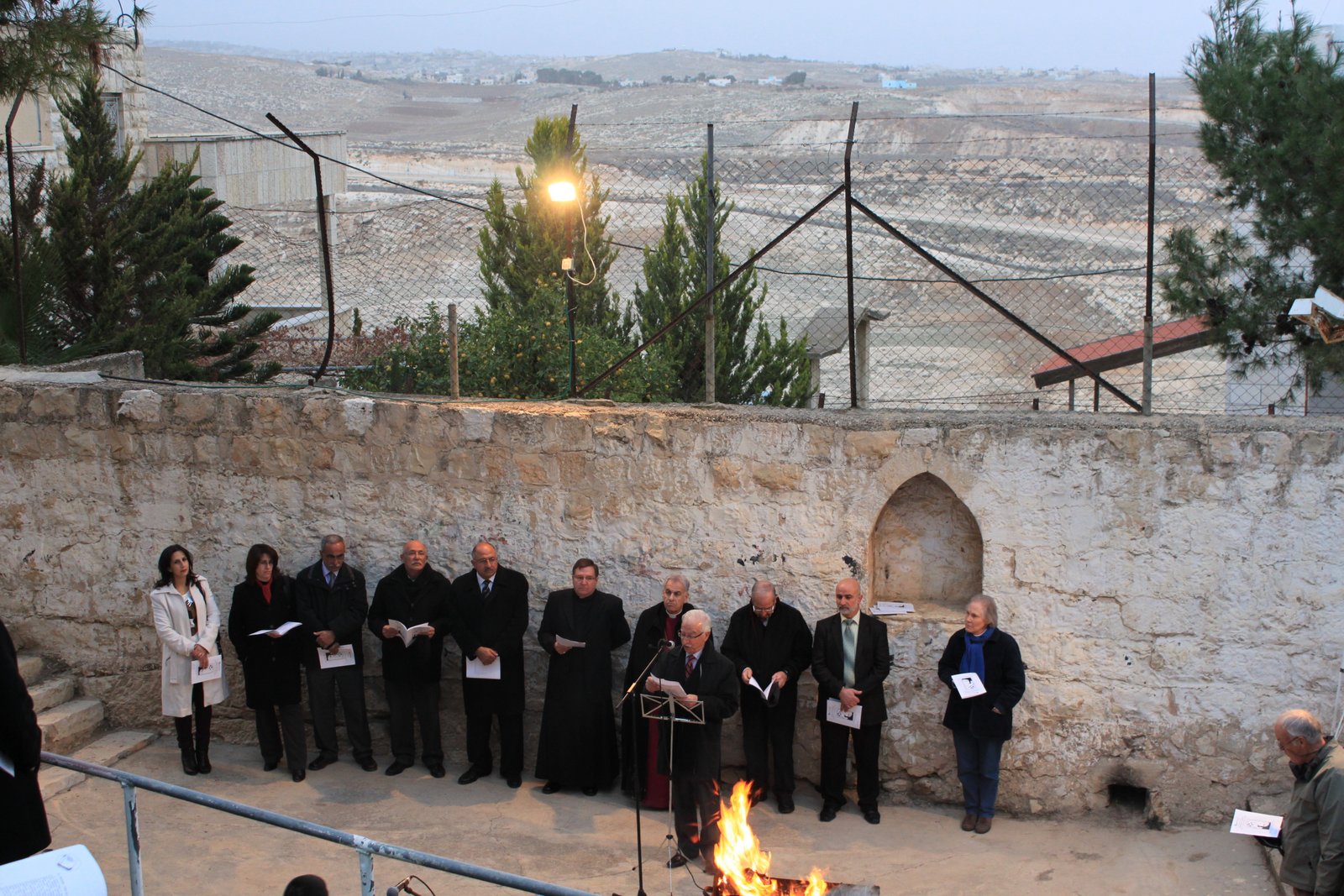
After the party went home, I went to a Lutheran/Catholic Christmas Eve service in Shepherd's Field. 


It was a beautiful service (more to come about it) and such an incredible experience to be sitting in Shepherds Field with members of several different denominations, singing and reading scriptures about the birth of the Savior. (And the Israeli settlement that is usually an affront to the eyes on the mostly-empty fields was just out of view, making the scene a bit more realistic!)


After the service, they shared lamb and pita (and the warmth of their fire) with everyone. So this Christmas Eve in Shepherds Field, instead of watching our flocks, we ate them.

Looking out over Beit Sahour and Bethlehem


Merry Christmas from the Koreans


And naturally, I had to throw in a picture of the Beit Sahour Christmas tree!


After a quick visit to Nativity Square (mostly to say that I had gone, like the thousands of people who come from all over the world to be there Christmas Eve) I walked home. And as it started to rain I saw, could it be, Santa! riding in a car and waving at everyone. Sahar told me that you can hire him out to come to your house and deliver presents to the children. Awesome.

Friday, December 30, 2011

Beit Sahour Christmas Tree Lighting

And for round #2 of the Beit Sahour Christmas tree lighting post:

Back in the middle of December was the Beit Sahour Christmas tree lighting celebration. The best part of this post was supposed to be the movies, but it is taking forever to upload them, so you get just one.

Anyway. Beit Sahour is a small town of about 12,000, and the Christmas tree lighting ceremony is a big deal. I swear half the city was there!


They even had a live band (all locals, of course)!


The Boy and Girl Scouts band marched through the middle, playing Christmas songs and causing a general ruckus as the throngs of people had to move aside and clear a space large enough for them to walk through the middle of the crowd.


The head of the Greek Orthodox church here spoke, as did an official from the Palestinian Authority. Nothing like a little political speech to put me in the spirit of Christmas! This year's speech was, of course, about the UN vote and wanting to celebrate Christmas next year in peace, joy, and the free state of Palestine. (At least he mentioned Christmas, right?)

Sahar and I were getting really claustrophobic and had to make an escape from the massive crowds that were pushing in on all sides. After pushing through the crowds, we finally found refuge next to the politician's car, which was conveniently located in the middle of the throngs of people but had a security guard standing by to make sure no one got too close to the car, leaving a wide open space. Although he glared at us a couple of times, Sahar and I took up camp next to the car. We made sure not to touch it, so I guess he didn't mind too much!


As soon as they lit the tree, fireworks went off and Sahar and I high-tailed it out of there so we wouldn't get stuck in traffic. And that's probably the thing I like most about crowded events...you wait for 2 hours in a suffocating crowd, fight your way to the edge 5 minutes before the actual event (which in this case lasted 2 minutes), and then run out before it's over so you don't get stuck in traffic.


But isn't it beautiful?

Sunday, December 18, 2011

Christmas Lights in Bethlehem

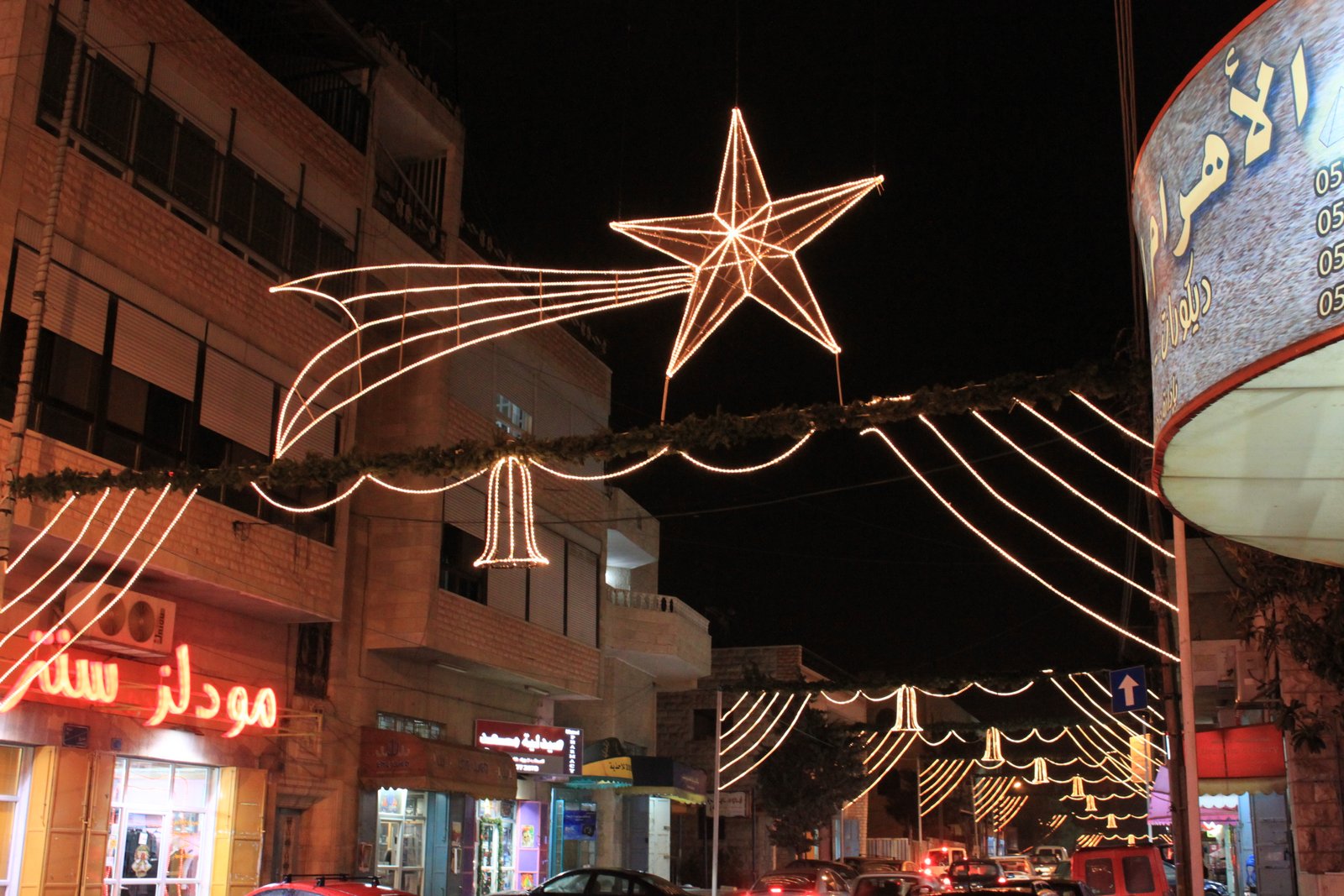
Since most people in the world (and even a lot of people in Israel!) can't come to Bethlehem to see the Christmas lights, I thought I'd do you all a favor and post pictures of them. I thought that I would be spending another year living in a country that doesn't celebrate Christmas, but since Bethlehem and Beit Sahour are Christian cities, I get my Christmas light fix every night!


This is in Manger Square, next to Church of the Nativity


Another view of Manger Square


The Church of the Nativity, marking the traditional spot where Jesus was born

These two pictures are blurry and don't do them justice, but you can see the lights stretched across the road and the Christmas tree in the middle of town. It's beautiful!


This church is right across the street from my house

Friday, December 16, 2011

You Can't Pay for Help Like This

I love living in a small Arab Christian city. There are lots of perks that come from living in Beit Sahour, even if it is a pain to cross a military checkpoint every day.

One of the best perks of living here (besides the price of chocolate, which is MUCH cheaper here than in Jerusalem!!) is that the people here are seriously so nice. And most of them speak very little English. Nice people + no English = an ideal living situation for me!

I usually get a ride from Beit Sahour to Bethlehem with Sahar, a friend from the branch who lives just a few blocks away. This saves me a lot of time and money every day, and I will be forever in her debt because of that! But the other day Sahar was sick and didn't go to work, so I had to find another way to the checkpoint.

A little after 6:30 am I walked to a central bus/taxi/service station about a block away from my house to find a way to the checkpoint. I had several options: I could take a bus (and then two service taxis; total cost 8.5 shekels, total time maybe 30 min), a taxi (total cost 15 shekels, total time about 8 min), or a service (pronounced ser-veese, a large van that functions as a taxi-bus, total cost (plus a service taxi from the drop-off point to the checkpoint) 6 shekels; total time maybe 15 min). Taking a service was my #1 option, but hundreds pass by each hour in the morning and I didn't want to have to stop each one and ask them where they were going (they don't all go to the same place). Flagging them down and asking them where they are going gets old after about 4 service.

So I did what I always do in this type of situation: I went into the vegetable store right next to the bus/service/taxi stop and asked the store owner if there were service from there to Bab-Alisqaq (where I could then catch a service taxi to the checkpoint). "Yes," he said, motioning for his coworker to walk back out with me. "Show her which service go to Bab-Alisqaq," he said.

I followed the man back outside and was pleasantly startled to see that he started flagging down the service and asking if they were going to Bab-Alisqaq. I could have hugged him! After flagging down 4 or 5 service with no luck, he finally found one going to Bab-Alisqaq. I thanked him and got in and he walked back into the store like it was no big deal, he just made some foreign girl's day. And I thought, "I couldn't pay for help like this, and he just did it to be nice!"

Yep. I love living here.

Saturday, November 26, 2011

The Move to Bethlehem: Part 1

I have been considering moving to Bethlehem for several weeks now, for several reasons. First of all, I wanted to be forced to speak Arabic every day...even when I was tired and didn't want to wander the streets of East Jerusalem to find someone to talk to. Secondly, the rent (and cost of living) is MUCH cheaper in Bethlehem, in part because it is behind the separation wall and the economic situation is not the best. And thirdly, I came here to experience life on both sides, and what better way to see what life is like in the West Bank than to live there?

With these considerations (and after a lot of prayer), I decided to move to Bethlehem. Sahar, a Palestinian member of the church who also lives in Bethlehem (and has been a great help and friend to me), had given me several options of people she knew who were renting out apartments, and I finally decided to go with one right next to the checkpoint. The house was surrounded on three sides by the separation wall (pictures to come) and seriously looked like a prison, but I decided I wanted to get the whole experience and so grabbed my stuff and move in.

The "apartment" was actually a guest house, with 5 or 6 rooms with private bathrooms. The kitchen and living room were shared, but other than that each room was private (although some rooms had 4 beds in them!). However, no one had been staying there for months, and the landlord said that no one was going to be there until Christmas (and then just for 2 nights), so I thought of it as moving into my own apartment and not a guesthouse.

Imagine my surprise when I opened the door to my new apartment with all of my luggage and saw a man sitting inside! "Oh, hi," he said. "Are you moving in too?"

Too? Too? No. No, I'm not moving in too. I'm moving in! This is my apartment! At least, that is what I thought it would be. I was so startled that I didn't say anything except a feeble "Hi, nice to meet you" and started taking my stuff back to my room. I was so shocked and overwhelmed that I didn't notice that there was a step down between the kitchen and my bedroom. I was carrying a large box filled with pots and other kitchen supplies, and as I stepped into my bedroom I missed the step and fell flat on my face, dropping the box and spilling the contents everywhere.

Unfortunately, the box also had a large bottle of canola oil in it, and when the box dropped the canola oil broke open and started spilling everywhere.

This was the last straw for me, and I did what any reasonable person would do: I started crying. And then walked out of the house to make some phone calls to see if I could get myself moved out of this awkward situation.

However, NO ONE was answering their phone. I walked back to the church in Bethlehem (my apt was 3 blocks away) to see if the people I was trying to get in contact with were there having a meeting, but the church was locked up and everyone was gone. And after about 14 phone calls with no luck, I finally called Arlissa, another member of my branch, and started crying. This was not what I was hoping for when I decided to move to Bethlehem!

Luckily for me, Sahar didn't stay in her meeting for too much longer and called me back as soon as she got done. "Is there some sort of emergency?" she wanted to know. "Because you called me like 9 times!"

Well, yes, there is an emergency. "There's a man living in my apartment!" I told her. She was just as shocked as me (thanks, Sahar, for validating my reaction!) and immediately asked if I wanted to go check out another apartment farther in the city. I went and spoke with the landlady and told her I felt awkward about the situation, and she totally understood and didn't even ask me to pay any rent (for the 1.5 hours I lived there...). And Sahar took me to another apartment, rented out by her niece, and not too far from where she herself lives.

Let me tell you, friends, that as soon as I saw the empty apartment (2 bedroom/1bath/kitchen/living room) and verified that no one else would be living there with me, I moved in that very night. It was actually more like 15 min. And let me tell you all, it has been amazing to have my own apartment! Of course, I don't have any mid-40s nice British men for roommates, but that is one thing I can do without!